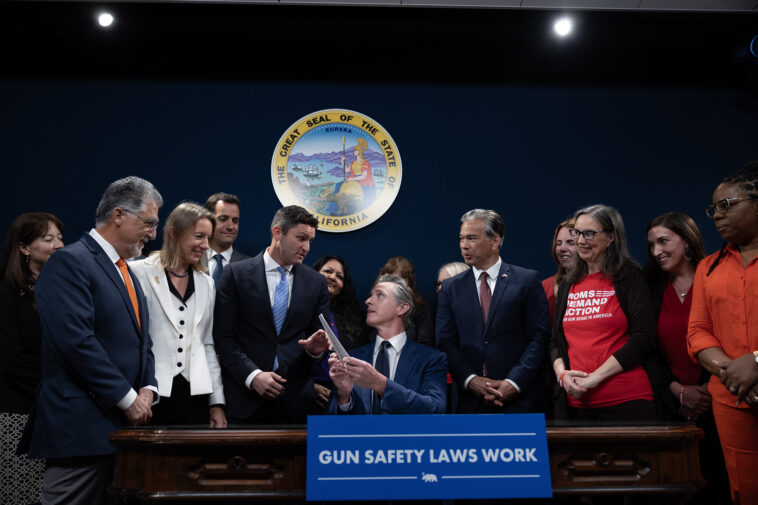

Examining California’s New Gun Conversion Ban
Governor Gavin Newsom’s recent signing of Assembly Bill 1127 has sparked a heated debate across California and beyond. This new law prohibits the sale of firearms that can be “readily converted by hand or with common household tools” into machine guns. In this opinion editorial, we take a closer look at the law’s finer details, discuss its potential implications, and explore the twisted issues that arise when balancing gun rights with public safety.
Understanding the Scope of AB 1127
Assembly Bill 1127 is designed to close a loophole that allows certain guns to be modified into fully automatic weapons. Specifically, the law targets firearms that can be easily transformed by someone using standard, everyday tools. By banning these convertible guns, the state of California aims to reduce the risk of dangerous modifications that could lead to more lethal firearms in circulation.
Key Provisions Explained
The main goal of the new legislation is to prevent the conversion of semi-automatic firearms into machine guns. Some of the essential details include:
- Definition of Convertible Firearms: The law focuses on guns that, with little effort and basic tools, could be altered into weapons with a much higher rate of fire.
- Intent Behind the Ban: The measure intends to address public safety concerns by eliminating the possibility of easily starting a chain reaction of modifications that could compromise community safety.
- Compliance Requirements: Retailers and manufacturers must now ensure that any firearms they sell meet the new standards, which adds an extra layer of oversight to the industry.
This approach is seen by proponents as a sensible measure to curb the availability of weapons that could be easily transformed into instruments of mass harm.
Historical Context and Legal Underpinnings
To fully grasp the implications of AB 1127, it is necessary to look at the history of gun regulation in California and the legal context in which this law was enacted. The state has a long-standing history of implementing strict gun control measures, particularly in response to tragic events and the evolving landscape of firearm technology.
The Evolution of Firearm Regulations
The journey toward stricter gun laws in California has been marked by several controversial and important milestones:
- A Shift Following Tragic Events: Over the past few decades, several high-profile incidents have prompted lawmakers to reevaluate existing gun laws and introduce measures aimed at preventing future tragedies.
- Changing Technological Landscape: The rapid evolution of firearm technology has presented regulators with new challenges. Modern firearms can be customized with relative ease, leading to the formative idea behind AB 1127.
- Legal Challenges and Adjustments: Previous legislative actions have sometimes met with lawsuits and public protests, often centered on constitutional concerns. AB 1127 follows in this tradition, as it is sure to face a critical look from various legal experts.
A Brief Overview of the Governing Legal Principles
AB 1127 sits at the intersection of state interests and constitutional rights. The law’s supporters argue that the measure is a necessary safety precaution, while opponents claim that it infringes on the rights of individuals who lawfully own firearms. In this dynamic environment, lawmakers attempt to steer through the tricky bits of constitutional law and public sentiment.
Implications for Gun Retailers and Manufacturers
Gun retailers and manufacturers in California are now faced with a set of challenges that require them to figure a path through a maze of legal obligations. The new regulation not only imposes additional burdens on those selling firearms but also reshapes the dynamic between industry players and regulatory bodies.
Adjusting Business Models in a Tense Regulatory Landscape
The impact on businesses involves several key aspects:
- Increased Compliance Costs: Retailers must invest in new training and compliance measures to ensure all products meet the criteria set forth in AB 1127. This includes verifying that the firearms being sold cannot be easily transformed into machine guns.
- Legal Risks and Potential Litigation: With high stakes on both sides, there is an increased possibility of legal challenges. Some retailers have already joined lawsuits arguing that the ban could be unconstitutional or interfere with market practices.
- Market Adjustments: Some industry experts predict that, by stirring up controversy, the law could inadvertently boost the market for certain “Glock-style” firearms, as manufacturers and retailers rush to adjust their offerings and marketing strategies.
Public Concerns and the Debate Over Gun Safety
The discussion over AB 1127 extends beyond legal technicalities, touching deeply on public concerns about gun safety. Opinions are highly polarized, with advocates on both sides of the debate bringing forward evidence and personal stories to support their positions.
Arguments in Favor of the Ban
Supporters of the new regulation emphasize its potential to save lives and reduce the risk of mass shootings. Their arguments often focus on the following points:
- Reducing the Lethality: By banning guns that can be trivially converted into machine guns, the law aims to lower the overall lethality of available firearms on the market.
- Preventing Dangerous Modifications: The measure is expected to impede modifications that can turn a standard handgun into a weapon with rapid-fire capability, making it potentially more dangerous in the hands of the wrong person.
- Strengthening Regulatory Frameworks: For many, the law represents a step toward closing existing loopholes and filling in some of the confusing bits of current firearm regulation.
Criticisms and Opposition to the Regulation
Critics argue that the ban is both overreaching and ultimately ineffective. Among the opposing viewpoints are these common themes:
- Constitutionality Concerns: Some argue that the law may be unconstitutional because it restricts law-abiding citizens’ rights. This sentiment is fueled by fears that such measures could lead to broader restrictions on firearm ownership.
- Ineffectiveness in Preventing Crime: Opponents contend that the ban addresses only a minor facet of the broader issue of gun violence. They argue that the majority of gun-related crimes are committed with weapons that are not easily convertible.
- Economic Impact on Retailers: Retailers claim that the law could harm their businesses by increasing operational costs and stifling innovation. Some view the new regulation as yet another obstacle in a regulatory overburdened industry.
- Political Overtones: For many, the controversy around AB 1127 is seen as yet another example of a government stance that disproportionately affects certain groups of citizens. Such critics describe the policy as loaded with political motivations rather than being solely a public safety measure.
Exploring the Constitutional Debate Around AB 1127
The constitutional validity of AB 1127 is one of the most contentious issues at hand. As legal experts and advocacy groups prepare to challenge or defend the law in court, several critical legal questions surface that merit careful examination.
Does the Ban Violate the Second Amendment?
One of the primary concerns raised by opponents of the law is that it may infringe upon the constitutional right to bear arms. To better understand this issue, consider the following aspects:
- Traditional Interpretation of the Second Amendment: Historically, the Second Amendment has been interpreted as providing a right to possess firearms for self-defense and other lawful purposes. Critics argue that any attempt to restrict certain types of firearms, even if they are modifiable, undermines this right.
- Precedent and Legal Interpretations: Courts have long grappled with finding the right balance between individual rights and public safety. AB 1127 will likely add another complex piece to the evolving jurisprudence surrounding firearm regulations.
- Scope of the Regulation: Supporters maintain that the law is narrowly tailored to address a specific risk – the conversion of firearms into more dangerous forms – and thus does not broadly impinge upon Second Amendment rights. They argue that the measure targets the method of conversion rather than the inherent right to firearm ownership.
Judicial Challenges on the Horizon
As similar gun control measures have faced legal challenges in the past, it is reasonable to expect that AB 1127 might be subjected to lawsuits for potentially overstepping constitutional boundaries. Some of the judicial hurdles that lie ahead might include:
- Scrutiny of Legislative Intent: Courts will likely probe the legislature’s intent behind the law. Was it genuinely enacted for public safety, or is it a means to push a broader ideological agenda?
- Precedent from Similar Cases: Previous rulings on similar firearm regulations will undoubtedly influence the interpretation of AB 1127. Legal experts are expected to compare this measure with past case law to decide if it stands up to constitutional scrutiny.
- Balancing Competing Interests: A key challenge for the courts will be finding an acceptable balance between curbing potential threats and preserving individual rights. This balancing act is full of problems and subtle details that state and federal courts have to weigh carefully.
Analyzing Social Media Responses and Public Sentiment
The new law has ignited widespread discussion on social media platforms, where users have voiced a dizzy mix of support, skepticism, and vehement opposition. The public reactions shed light on the highly charged atmosphere surrounding the gun control debate in the United States.
Reactions from Various Corners of the Political Spectrum
The responses range from cautious endorsement to outright dismissal of the law. Notably, some common remarks include:
- Skepticism Over Practical Impact: One user questioned the likelihood that individuals would convert handguns into automatic weapons, suggesting that emptying a clip in seconds could render accuracy moot. This viewpoint highlights the belief that the measure might be addressing a problem that rarely occurs.
- Defense of Existing Firearm Rights: Other voices argued firmly that law-abiding citizens should retain the right to own any handgun or long gun, provided they adhere to existing safety protocols such as trigger locks and proper registration. These contributors often suggest that the proposed ban infringes on long-standing rights without effectively addressing societal issues.
- Frustration with Political Dynamics: Certain social media comments reveal a blend of anger and cynicism about the role of government in regulating firearms. Some posts tied the new law to broader concerns about political overreach, with pointed references to other contentious political issues.
Below is a table summarizing several viewpoints shared on social media:
| Commenter | Main Argument | Tone |
|---|---|---|
| Marek Korzeniowski | Questions the frequency and practicality of converting handguns into automatic weapons | Skeptical and practical |
| Sebastian Aldrete | Asserts that law-abiding citizens maintain the right to own various firearms with proper security measures | Defensive and traditional |
| Bill Burns | Highlights ideological differences between political groups and hints that some regulations may be politically motivated | Satirical and critical |
| Tony Marulli | Points out that misuse of firearms often stems from a lack of proper training rather than the guns themselves | Analytical and safety-oriented |
The Political Underpinnings and Broader Implications
The debate over gun control in California is deeply intertwined with broader political dynamics and ideological divides that go beyond the specifics of AB 1127. Critics and defenders alike often use such legislative measures to highlight the twisted issues at the heart of American political life.
Partisan Perspectives on Firearm Regulations
Many commentators see the law as a clear example of the political tug-of-war over gun rights. Some arguments in this realm include:
- Accusations of Political Bias: Certain critics argue that the measure disproportionately affects one political group over another. They contend that while there is a rush to implement restrictions on certain types of guns, other forms of regulation that might impact different weapons remain unaddressed.
- Concerns Over Government Overreach: Another common complaint is that the law is a step toward an intimidating accumulation of state power, where the government might soon restrict other personal freedoms under the guise of public safety.
- Market Reactions as Political Statements: Some industry watchdogs predict that the controversy stirred up by AB 1127 may lead to an ironic surge in sales of alternative firearms, as retailers exploit the attention generated by the legislative change for free marketing.
Impact on Gun Retailers and Broader Economic Considerations
The law has not only sparked outcry among political enthusiasts but also raised practical concerns among those directly involved in the firearm industry. For gun retailers, the ban represents both a challenge and a potential opportunity:
- Adapting to New Market Conditions: Retailers in areas like Poway are now reevaluating their inventory and marketing strategies. Some have even joined lawsuits to challenge the ban, signaling that they see potential economic repercussions.
- Cost Implications: Increased compliance checks, revised product lines, and the need for enhanced training are all factors that translate into tangible costs for the industry. Retailers must now work through more nerve-racking regulatory hoops to sustain their businesses.
- Future Outlook: Whether the law will ultimately curb dangerous modifications or inadvertently boost sales due to its publicity remains a matter of debate. The economic impact, while hard to predict, is expected to be significant in the coming years.
Gun Safety, Public Health, and the Debate on Mental Health
Any discussion involving firearms inevitably loops in the issue of public safety. While AB 1127 is focused on the technical aspects of firearm modification, the real-world implications extend far beyond legislative details. Many argue that solving gun violence requires addressing additional factors such as mental health care and community support.
Gun Safety Measures Versus Broader Societal Issues
Critics of the law maintain that gun safety is a multifaceted issue, and focusing solely on conversion bans overlooks several overlapping problems. Important points include:
- Training and Education: One viewpoint stresses that guns, regardless of their form, are not the problem on their own. Instead, insufficient training and improper use are often at the heart of tragic incidents. There is a call for more comprehensive education on safe firearm handling.
- Mental Health Systems: Many believe that improving mental health support and intervention programs could address the root causes of gun violence more effectively than additional regulation on certain types of firearms.
- Systemic Issues: Some commentators argue that regulatory measures like AB 1127 are mere band-aids on a system riddled with constraint and tension. They suggest that significant improvements in community-based programs and law enforcement might yield better results.
Balancing Firearm Rights with Community Safety
At the core of the debate lies the challenge of achieving a balance between preserving individual firearm rights and enhancing public safety. Consider these critical aspects:
- Maintaining Constitutional Protections: For many, the right to bear arms is not negotiable. They argue that laws should not impede this freedom so long as the regulation does not stray into the dangerous territory of infringing on personal rights.
- Implementing Practical Safety Precautions: Proponents of AB 1127 suggest that by focusing on firearms that can be quickly and easily converted into machine guns, the law targets a specific risk without broadly limiting firearm ownership. This approach is seen as a measured attempt to reduce the potential for extreme violence while preserving general rights.
- Broader Societal Impact: Beyond gun conversion issues, many insist that additional measures—such as better law enforcement training and stronger community engagement—are essential to address the overall challenge of gun violence. Simply banning convertible firearms may not be enough to create safer communities.
Potential Long-Term Outcomes and Future Legal Battles
It is clear that the introduction of AB 1127 has set the stage for a long, winding road of legal, economic, and societal implications. As debates heat up and lawsuits loom, both supporters and opponents of the law are preparing for an extended confrontation in court and in public opinion.
Forecasting Legal Interpretations and Challenges
Legal experts predict several possible outcomes as challenges to AB 1127 move forward:
- Judicial Scrutiny: The courts may take a close look at the state’s justification for the law and its implementation measures. This will involve working through legal precedents, assessing legislative intent, and considering whether the law is narrowly focused enough to avoid broader constitutional issues.
- Legislative Amendments: Depending on early court rulings and public response, lawmakers might choose to revise or clarify certain aspects of the law. This could involve amending related provisions to ensure that the regulation addresses the intended risks without compromising widely held rights.
- Court of Public Opinion: Beyond the courtroom, public sentiment and media portrayal will play a significant role in shaping the discourse around AB 1127. Increased debate might drive both further regulatory refinement and calls for more comprehensive national standards on gun control.
Implications for Future Gun Legislation
The debate around AB 1127 is indicative of broader trends in American firearm regulation. Observers note the following potential long-term implications:
- Incremental Changes in Gun Policy: This law might pave the way for additional targeted measures aimed at addressing emerging risks related to firearm technology. Lawmakers could continue to focus on specific issues that, when combined, form a more comprehensive regulatory framework.
- Heightened Vigilance Among Gun Owners: As regulations become more complex, gun owners may need to be more proactive in staying informed about their rights and responsibilities. This could lead to increased efforts by advocacy groups on both sides of the debate to educate their members about the subtle details of changing gun laws.
- Political and Economic Ripple Effects: The regulation’s impact on sales, liability issues, and business practices might have a lasting effect on the firearm industry. With retailers and manufacturers retooling their operations, there is potential for significant shifts in market dynamics and political alliances.
Case Study: How Local Retailers Are Adapting
A closer examination of local gun retailers in areas such as Poway reveals the direct economic and legal effects of AB 1127. Some retailers have immediately taken steps to adjust their practices, while others have joined legal action to challenge the law.
Operational Changes and Compliance Strategies
Retailers are employing several strategies to adjust to the new regulatory framework:
- Enhanced Product Vetting: Businesses now have to inspect their inventory thoroughly to ensure that no firearm offered can be easily converted into an automatic weapon. This increased scrutiny is part of a broader move to conform with the letter – and spirit – of the law.
- Staff Training Initiatives: Training programs have been ramped up to educate sales personnel on new compliance requirements. By teaching staff to identify potentially modifiable firearms, retailers aim to reduce legal exposure and maintain credibility with their customers.
- Legal and Regulatory Consultation: Many businesses are now consulting legal experts to understand the fine points behind the law’s implementation. This proactive approach helps them stay ahead of possible challenges and better manage their obligations under current statutes.
Table: Retailers’ Strategies to Cope with the New Regulations
| Strategy | Description |
|---|---|
| Product Vetting | Enhanced inspections of firearm inventory to ensure compliance with conversion ban provisions. |
| Staff Training | Educating sales and support teams on identifying and handling modifiable firearms. |
| Legal Consultation | Engaging with legal experts to navigate the tangled issues of compliance and potential litigation. |
| Market Readjustment | Modifying marketing strategies to highlight compliance and safety, while addressing consumer concerns. |
Taking a Closer Look at the Broader Gun Safety Landscape
While AB 1127 specifically addresses the conversion of firearms into more dangerous forms, it is important to remember that gun safety is a broad issue full of problems. A holistic approach to reducing gun violence must consider several related factors, such as responsible gun ownership, proper training, and improved mental health systems.
Beyond the Conversion Ban
The conversion ban addresses only one piece of the puzzle. For many observers, the following additional areas demand equal attention:
- Accountability and Training: There is a growing push for mandatory gun safety courses and better training programs. The aim here is to ensure that gun owners are familiar with the safe handling and storage of firearms, thereby reducing accidents and improper uses.
- Mental Health Initiatives: Advocates argue that a more robust mental health system would help address some of the root causes behind gun violence. Improved access to mental health care could, in theory, reduce the instances where firearms are misused or used impulsively.
- Community-Based Interventions: Focusing on community safety, law enforcement, and social services may offer a more nuanced approach to preventing violent incidents. Efforts in this area include neighborhood watch programs, local conflict resolution initiatives, and better support systems for at-risk individuals.
Conclusion: Balancing Regulation and Rights in a Changing Landscape
Assembly Bill 1127 signals a significant turning point in California’s approach to gun safety and firearm regulation. By targeting guns that can be easily converted into machine guns, the law is intended to curb some of the dangerous modifications that have long been a point of contention. The measure, however, also opens up a host of tangled issues—ranging from constitutional challenges to economic impacts on retailers—that will likely prompt further debate and legal battles in the coming years.
As lawmakers, legal experts, and advocacy groups continue to figure a path through these complicated pieces, society at large is forced to confront a familiar conundrum: How do we strike a balance between individual rights and the collective need for safety? The answers are not simple. They require us to poke around the subtle parts of both constitutional law and public sentiment, all while ensuring that any steps taken do not inadvertently ignite even more nerve-racking debates.
For now, AB 1127 remains a hotly contested piece of legislation. Whether it serves as an effective tool for reducing gun violence or becomes a flashpoint in broader cultural and political conflicts depends on the unfolding legal battles and the ongoing dialogue between lawmakers and the public. In a nation where the right to bear arms is both celebrated and lamented, it is clear that any regulation—no matter how well-intentioned—will always be met with a mix of support, skepticism, and fierce opposition.
In the end, the story of AB 1127 is a microcosm of the larger, ongoing debate over gun control in America. It forces us to take a closer look at the delicate and often tense balance between making our society safer and preserving the freedoms that many hold dear. As this legislative chapter continues to unfold, one thing remains clear: the twists and turns of firearm regulation are far from over, and the conversation is poised to evolve along with the law itself.
The coming months and years are likely to see further legal challenges, more detailed analyses, and perhaps even additional legislative amendments. Whatever the outcome, AB 1127 has already made an indelible mark on the discourse around gun laws in California, and its effects will reverberate well beyond the borders of the state.
For those invested in the ongoing discussion—whether as legal experts, political advocates, or concerned citizens—the unfolding legal saga offers a sobering reminder: in the realm of gun safety and constitutional rights, every policy decision carries both measurable consequences and a host of unintended, often complicated, side effects. Only time will tell which side of the debate will ultimately prevail, but the dialogue itself remains an essential, if challenging, part of our American discourse.
Originally Post From https://www.facebook.com/KUSINews/posts/governor-gavin-newsom-signed-ab-1127-into-law-banning-the-sale-of-guns-that-can-/1248665917306370/
Read more about this topic at
Machine-gun Conversion Ban – Alabama Legislative Scorecard
GUN CONVERSION BAN: Alabama Gov. Kay Ivey signed …